The post Top CRM Platforms appeared first on Tech Empire Solutions.
from Tech Empire Solutions https://techempiresolutions.com/top-crm-platforms/
via https://techempiresolutions.com/
Welcome to Tech Empire Solutions! At Tech Empire Solutions, we’re dedicated to revolutionizing the way technology influences our lives. Founded with a vision to innovate, inspire, and redefine the tech landscape, we are committed to providing cutting-edge solutions and insights that propel businesses and individuals towards success in the digital era.
The post Top CRM Platforms appeared first on Tech Empire Solutions.

The post New Recipe Website Allows To Sort By Ingredient appeared first on Tech Empire Solutions.

The Kimsuky (aka Springtail) advanced persistent threat (APT) group with ties to North Korea’s Reconnaissance General Bureau (RGB) has been observed deploying a Linux version of the GoBear backdoor as part of a campaign targeting South Korean groups.
back door, code name Gomir“Structurally almost identical to GoBear, code is widely shared between malware variants,” Broadcom’s Symantec Threat Hunters team said in a new report. “Any functionality in GoBear that relies on the operating system is either missing in Gomir or has been re-implemented.”

GoBear was first documented by South Korean security firm S2W in early February 2024 in connection with a campaign to spread malware called Troll Stealer (aka TrollAgent), which overlapped with known Kimsuky malware families such as AppleSeed and AlphaSeed. .
Subsequent analysis by the AhnLab Security Intelligence Center (ASEC) revealed that the malware was distributed via a Trojan security program downloaded from the website of the Korean Construction Related Association.
These include nProtect Online Security, NX_PRNMAN, TrustPKI, UbiReport, and WIZVERA VeraPort, the last of which was previously subject to a software supply chain attack by Lazarus Group in 2020.
Symantec said it has also observed the Troll Stealer malware being spread through a malicious installer from Wizvera VeraPort, but it is not yet clear the exact distribution mechanism used to spread the installer.
“GoBear also contains similar function names to the older Springtail backdoor BetaSeed, which was written in C++, suggesting a common origin for both threats,” the company noted.
The malware supports the execution of commands received from a remote server and is also said to be spread via a fake installer implant disguised as a Korea Transportation Organization application.

Its Linux counterpart, Gomir, supports up to 17 commands, allowing its operators to perform file operations, launch reverse proxies, suspend command and control (C2) communications for a specified period of time, run shell commands, and terminate their own command programs.
“The latest Springtail campaign provides further evidence that software installation packages and updates are now among the most favored infection vectors for North Korean espionage actors,” Symantec said.
“The targeting software appears to have been carefully selected to maximize the chance of infecting South Korean targets.”
The post Kimsuky APT deploys Linux backdoor Gomir in South Korean cyber attacks appeared first on Tech Empire Solutions.
Slack trains machine learning models on user messages, documents, and other content without explicit permission. Training is opt-out, which means your private information will be stolen by default. Worse, you have to ask your organization’s Slack administrator (HR, IT, etc.) to send an email to the company asking it to stop. (You can’t do it yourself.) Welcome to the dark side of the new gold rush for artificial intelligence training materials.
Corey Quinn, a senior director at DuckBill Group, discovered the policy in an introduction to Slack’s Privacy Principles and posted it on X (via PCMag). The section reads as follows (emphasis ours): ” Develop artificial intelligence/machine learning models,our system Analyze customer data (For example Messages, content and files) submitted to Slack and Other information (including usage information) as defined in our Privacy Policy and your Customer Agreement.
The opt-out process requires that you complete all work to protect your data. According to the Privacy Statement, “To opt out, please have your organization or workspace owner or primary owner contact our Customer Experience team at feedback@slack.com and provide your workspace/organization URL and topic Run ‘Slack Global Model Opt-Out Request’.’ Once the opt-out is complete, we will process your request and respond.
Sorry, Slack, what the hell are you doing with user DMs, messages, files, etc.? I’m sure I didn’t read the article correctly. pic.twitter.com/6ORZNS2RxC
— Corey Quinn (@QuinnyPig) May 16, 2024
The company responded to Quinn’s message on Generating) machine learning models.
It’s unclear how long ago the Salesforce-owned company included this tidbit in its terms. Saying customers can opt out, when “customers” does not include employees working within the organization, is misleading at best. They have to ask the people who handle Slack access in their businesses to do this – I hope they will oblige.
Inconsistencies in Slack’s privacy policy add to the confusion. One section states, “Slack does not have access to the underlying content when developing AI/ML models or otherwise analyzing customer data. We have various technical measures in place to prevent this from happening. However, the machine learning model training policy appears to be inconsistent with This statement is contradictory and leaves a great deal of room for confusion.
Furthermore, Slack’s web page marketing its premium generative AI tool reads: “Work without worries. Your data is your data. We don’t use it to train Slack AI. Everything is built on Slack’s secure foundation Run on a facility that meets the same compliance standards as Slack itself.
In this case, the company is talking about its premium generative artificial intelligence tools, separate from the machine learning models it trains without explicit permission.However, as PCMag points out that implying that all of your data is unaffected by AI training is, at best, a highly misleading statement, since companies can obviously choose which AI models are covered by that statement.
Engadget tried contacting Slack through multiple channels, but had not received a response as of press time. We will update this story if we hear back.
The post Slack has been scanning your messages to train its artificial intelligence model appeared first on Tech Empire Solutions.
We might be getting a closer look at Motorola’s next foldable phone.Connect the leak point to 91 mobile phone (via 9 to 5 google) and longtime device leaker Evan Blass have shown off the entry-level Moto Razr 50 and high-end Razr 50 Ultra (likely to be called the 2024 Razr and Razr+ in the US) in various colors from various angles.
Leaked information points to the high-end Razr+ (2024) (also known as the Razr 50 Ultra), which runs on a Snapdragon 8s Gen 3 chip and has 12GB of RAM and 256GB of storage. It is expected to be equipped with a 6.9-inch OLED display with a resolution of 2,640 x 1,080 on the inside and a 3.6-inch cover display on the outside. A 50MP wide-angle camera paired with a 50MP telephoto lens, a 32MP front-facing sensor, and a 4,000mAh battery round out the (alleged) specs.
Leaked images of the flagship model reveal it will be available in dark blue, dark green, peach and pink colours.
Meanwhile, the entry-level Razr (2024) – likely to be called the Razr 50 outside the US – will reportedly run a MediaTek Dimensity 7300 processor, which is different from the Snapdragon 7 Gen 1 found in its 2023 counterpart. Another noticeable change compared to its predecessor is its purported 3.63-inch display, which is a big improvement over last year’s budget model’s 1.5-inch outward-facing screen.
The leaks show no sign of a sleek wood option in Motorola’s Edge 50 phone range, which was launched last month. Old-school smartphone enthusiasts will remember that this is a throwback to 2013’s Moto X, when the company was owned by Google. (It has been under Lenovo since 2014.)
You can check out the leaked image gallery below, courtesy of Blass and 91 mobile phone.
The post Motorola’s 2024 Razr series may feature larger screen covers for budget models appeared first on Tech Empire Solutions.
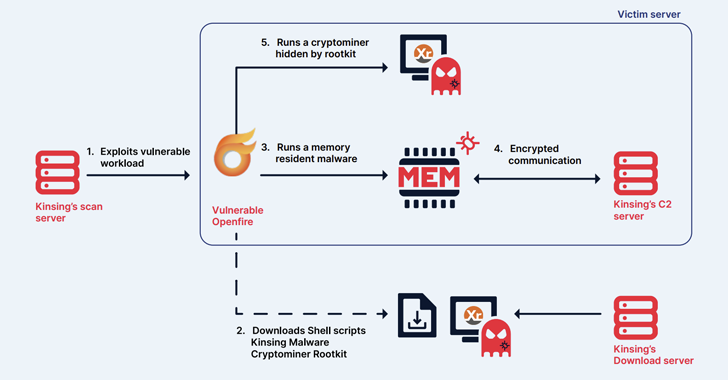
The cryptojacking group is called Jinxin It has demonstrated its ability to evolve and adapt, proving to be a persistent threat by rapidly incorporating newly revealed vulnerabilities to exploit its arsenal and expand its botnet.
The findings come from cloud security company Aqua, which describes the threat actors as actively orchestrating illegal cryptocurrency mining operations since 2019.
Kinsing (aka H2Miner) is the name of the malware and the adversary behind it, which continues to expand its toolkit with new vulnerabilities to register infected systems into cryptocurrency mining botnets. TrustedSec first documented it in January 2020.
In recent years, campaigns involving Golang-based malware have exploited various flaws in Apache ActiveMQ, Apache Log4j, Apache NiFi, Atlassian Confluence, Citrix, Liferay Portal, Linux, Openfire, Oracle WebLogic Server, and SaltStack to compromise vulnerable system.
Other methods involve leveraging misconfigured Docker, PostgreSQL, and Redis instances to gain initial access and then marshalling the endpoints into a botnet for cryptomining, but not before deactivating security services and removing installed files on the host. Rival miners.
Subsequent analysis by CyberArk in 2021 found commonalities between Kinsing and another malware called NSPPS, concluding that the two viruses “represent the same family.”
Kinsing’s attack infrastructure is divided into three main categories: initial servers used to scan and exploit vulnerabilities, download servers responsible for staging payloads and scripts, and command and control (C2) servers that maintain contact with infected servers. device.
The IP address used for the C2 server resolved to Russia, while the IP addresses used to download scripts and binaries spanned countries such as Luxembourg, Russia, the Netherlands, and Ukraine.
“Kinsing uses different tools for different operating systems,” Aqua said. “For example, Kinsing often uses shell and Bash scripts to exploit Linux servers.”
“We also found Kinsing using PowerShell scripts to target Openfire on Windows servers. When running on Unix, it typically downloads binaries that run on x86 or ARM.”
Another noteworthy aspect of the threat actor’s activity is that 91% of targeted applications were open source, with the group primarily targeting runtime applications (67%), databases (9%), and cloud infrastructure (8).
 |
| Image source: Forescout |
Extensive analysis of the artifacts further revealed three distinct categories of procedures –
For its part, the malware is designed to keep an eye on the mining process and share its process identifier (PID) with the C2 server, perform connection checks and send execution results, etc.
“Kinsing targets Linux and Windows systems, often by exploiting vulnerabilities in web applications or misconfigurations such as the Docker API and Kubernetes to run cryptocurrency mining programs,” Aqua said. “To prevent potential threats like Kinsing , proactive measures such as strengthening pre-deployment workloads are critical.”
The disclosure comes as botnet malware families are increasingly looking for ways to expand their reach and recruit machines into networks to carry out malicious activities.
The best example is P2PInfect, a Rust malware that was found to exploit less secure Redis servers to deliver variants compiled for the MIPS and ARM architectures.
Nozomi Networks, which discovered the sample targeting ARM earlier this year, said: “The main payload is capable of performing various operations, including propagating and delivering other modules with self-explanatory file names such as miner and winminer.”
“As the name suggests, the malware is capable of performing peer-to-peer (P2P) communications without relying on a single command and control server (C&C) to deliver the attacker’s commands.”
The post Kinsing hacker group exploits more flaws to expand botnet used for cryptojacking appeared first on Tech Empire Solutions.
Google has updated some accessibility apps and added features to make them easier to use for people who need them. It has launched a new version of its Lookout app that can read text and even lengthy documents aloud for people with low vision or blindness. The app can also read food labels, identify currency, and tell users what they see through the camera and images. Its latest version comes with a new “Find” mode that allows users to choose from seven item categories, including seats, tables, vehicles, tableware and bathrooms.
When the user selects a category, the app will be able to identify the objects associated with it as the user moves the camera around the room. It then tells them the direction or distance to the object, making it easier for users to interact with their surroundings. Google is also launching an in-app photo button so they can take a photo and quickly get an AI-generated description.
The company has also updated its Look to Speak app. Look to Speak enables users to communicate with others by selecting from a list of phrases they want the app to speak aloud using eye gestures. Now, Google has added a text-less mode that lets them trigger speech by selecting from an album containing a variety of emojis, symbols, and photos. Even better, they can personalize what each symbol or image means to them.
Google has also expanded the screen reader functionality of Lens in Maps so that it can tell users the names and categories of places they see, such as ATMs and restaurants. It can also tell them how far away a particular location is. Additionally, it is rolling out improvements to detailed voice guidance, which provides audio prompts telling users where they should go.
Finally, four years after the launch of Maps for Android and iOS, Google is finally making wheelchair information available on the desktop. The Accessibility feature allows users to see if the place they are visiting can meet their needs – for example, businesses and public spaces with accessible entrances will display a wheelchair icon. They can also use the feature to see if a location has accessible restrooms, seating, and parking. Maps currently has accessible information for more than 50 million places, the company said. Those who like to find wheelchair information on Android and iOS can now also easily filter reviews that focus on wheelchair access.
Google made all of these announcements at this year’s I/O developer conference, where it also revealed that it’s open sourcing more code for its Gameface hands-free “mouse” project, allowing Android developers to use it in their apps . The tool allows users to control cursors through head movements and facial expressions so they can use computers and mobile phones more easily.
Stay up to date with all the news from Google I/O 2024 here!
This article contains affiliate links; if you click on such links and make a purchase, we may earn a commission.
The post Google’s accessibility app Lookout uses your phone’s camera to find and identify objects appeared first on Tech Empire Solutions.
How to Login to Chuzo Are you having trouble logging into Chuzo? Let’s explore this guide to trouble shoot your problems. Make Sure...

