Tuesday, January 23, 2024

The ‘Mother of Data Breaches’ Has Leaked 26 Billion Records, But Don’t Panic

A database containing 26 billion leak records has been discovered, dubbed the “mother of all leaks.” Luckily, it’s actually not as bad as it sounds.

The massive 12 TB leak was discovered by cybersecurity researcher Bob Dyachenko in collaboration with the Cybernews team. It’s unclear who is responsible for the database, but it contains credentials and sensitive material.

This is undoubtedly bad news. It is never a good thing to have your personal data exposed online as anyone can find it and use it for nefarious purposes. However, the situation is far less catastrophic than it seems.

See also:

As far as we know, the Xfinity data breach affected more than 35 million people

This leak is actually a compilation of information from thousands of previous leaks and does not appear to contain any new information. If you stay up to date on the latest safety information, you should be no more worried than you were yesterday. It is also reasonable to expect that some records are duplicates, so there are not necessarily 26 billion unique records.

Even so, that doesn’t mean you should be complacent. Given the sheer volume of the material and the number of leaks it involves, there’s a good chance your material will be included, even if it’s from a leak you already know about that happened years ago. This is a good reminder to update your security hygiene and maybe change some passwords.

Tencent was the most affected by the breach, with a total of 1.5 billion records included. This was followed by Chinese social media platforms Weibo (504 million), MySpace (260 million), Twitter (281 million) and Wattpad (271 million). Other brands include LinkedIn, AdultFriendFinder, Adobe, MyFitnessPal and Canva.

Government organizations are not immune, with the United States, Brazil, Germany, Turkey and the Philippines included in the compiled database.

You can use tools like Have I Been Pwned or Cybernews’ Breach Checker to find out if you’ve been the victim of a data breach. If you haven’t done so already, consider using a password manager. It may not prevent leaks, but it will make it easier to use unique passwords for all your accounts.


Source link


from Tech Empire Solutions https://techempiresolutions.com/the-mother-of-data-breaches-has-leaked-26-billion-records-but-dont-panic/
via https://techempiresolutions.com/

FTC’s Lord & Taylor case: In native advertising, explicit disclosure is always fashionable

This is a flattering dress with spaghetti straps, an engineered paisley print and an asymmetrical hem. It is at the center of an enforcement action against department store chain Lord & Taylor for its alleged deceptive use of native advertising — the first such case since the FTC issued an enforcement policy statement in December. The lawsuit also challenges Lord & Taylor’s “product bomb” campaign on Instagram as misleading.

Lord & Taylor has used widespread social media to drive the launch of Design Lab, its own clothing line aimed at women aged 18 to 35. The strategy was interesting: focus on just one item—the paisley asymmetrical dress.

For the local advertising portion of the campaign, Lord & Taylor signed a contract with online fashion magazine Nylon to publish an article about the Design Lab collection, which included photos of paisley dresses. Lord & Taylor reviewed and approved the paid Nylon article without requiring disclosure of its commercial arrangements.

Additionally, Lord & Taylor contracted with Nylon to post photos of paisley dresses on Nylon’s Instagram page. Lord & Taylor again reviewed and approved the paid post without requiring disclosure.

This is just part of the campaign. Lord & Taylor has also recruited a team of fashion influencers who all have two things in common: a sense of style and large followings on social media platforms.

Lord & Taylor gave the dress to 50 influencers and paid them $1,000 to $4,000 to post themselves wearing it on Instagram during a designated “Product Bomb” weekend in March 2015 Photos of the dress – the same weekend Nylon posted photos of Lord & Taylor-approved products. Lord & Taylor tells influencers you can style the dress however you want, but otherwise the contract is strictly business. Influencers must: 1) use the @lordandtaylor Instagram handle and the campaign hashtag #DesignLab in the photo caption; 2) tag the photo @lordandtaylor.

Representatives from Lord & Taylor pre-approved each influencer’s Instagram posts to ensure they included the required hashtags and Instagram names. The company also edits some of the content the influencers plan to publish.

While the company has taken a meticulous approach to hashtags, handles, and more, Lord & Taylor has been strangely silent on other key aspects of the campaign. For example, according to the FTC, Lord & Taylor’s contracts do not require influencers to disclose that Lord & Taylor has paid them. Additionally, none of the Lord & Taylor-approved Instagram posts disclosed that the influencer received the dress for free, that she was compensated for the post, or that the post was part of a Lord & Taylor advertising campaign. As the complaint alleges, Lord & Taylor did not add a disclosure to this effect to any of the influencer posts it reviewed.

Instagram activity reached 11.4 million individual users and generated 328,000 brand interactions (likes, comments, retweets, etc.) through Lord & Taylor’s Instagram handle. The paisley dress is also sold out.

The FTC complaint charges Lord & Taylor with three separate violations: 1) Lord & Taylor falsely represented that 50 Instagram images and captions reflected independent statements by unbiased fashion influencers, when in fact they were Lord & Taylor advertisements part of a campaign to promote sales of a new product line; 2) Lord & Taylor failed to disclose that the influencers were paid endorsers of the company—a link that is important to consumers; 3) Lord & Taylor wrongly Nylon’s articles and Instagram posts reflect Nylon’s independent opinions on the Design Lab series, when in fact they are paid advertisements.

Under the terms of the proposed settlement, Lord & Taylor is prohibited from falsely claiming, expressly or implicitly, that endorsers are independent users or ordinary consumers. If there is a material connection between the company and the endorser, Lord & Taylor must clearly disclose this connection “in close proximity” to the statement. Lord & Taylor cannot suggest or imply that paid advertising is a statement or opinion from an independent or objective publisher or source. You may submit online comments on the proposed settlement until April 14, 2016.

What does the Lord & Taylor case suggest about your company’s social media activities?

If you use native ads, consider context. As the Federal Trade Commission explains in Native Advertising: A Guide for Businesses, “The watchword is transparency. An advertisement or promotional message should not suggest or imply to consumers that it is not an advertisement.” Never have industry expertise on new forms of promotion Review your native advertising from a knowledgeable consumer perspective.

If there are significant connections between your company and the endorser, disclose them. What is a material connection? According to the Federal Trade Commission’s Endorsement Guidelines, the connection between the endorser and the seller can have a significant impact on the weight or credibility given to an endorsement by consumers. Read the FTC’s Endorsement Guidelines: What People Ask for for specific compliance advice, and apply these principles if you recruit influencers, bloggers, or others in your marketing campaigns.

Disclosure of significant connections must be clear and conspicuous. How about explaining the substantive connection in a footnote, behind a vague hyperlink, or in a general About Me or Info page? No, no, nor. As with any major disclosure, companies should place the disclosure where consumers can see and read it. Of course, the terms of the Lord & Taylor settlement apply only to that company, but a good rule of thumb for prudent marketers is this order of standards: “very close” claims.

Train your affiliates and monitor what they do on your behalf. If your company uses social media campaigns like this, make your expectations clear to influencers from the beginning and follow an effective compliance program. There’s no one-size-fits-all approach, but the Federal Trade Commission’s Endorsement Guidelines: What People Ask for list elements that each plan should include:

  1. Since advertisers have the responsibility to substantiate objective product claims, explain to your connections claims you can back up;
  2. Tell them they have a responsibility to disclose contact with you;
  3. Search regularly to ensure they follow your instructions; and
  4. If you spot questionable practices, follow up.

Source link


from Tech Empire Solutions https://techempiresolutions.com/ftcs-lord-taylor-case-in-native-advertising-explicit-disclosure-is-always-fashionable/
via https://techempiresolutions.com/

Monday, January 22, 2024

Voice cloning startup ElevenLabs raises $80 million, achieves unicorn status

There’s a lot of money in voice cloning.

Case in point: ElevenLabs, a startup developing artificial intelligence tools to create and edit synthetic sounds, today announced the completion of an $80 million Series B round of financing from well-known names such as Andreessen Horowitz, former GitHub CEO Nat Friedman, and entrepreneur Daniel Gross. The investors co-led the investment. .

This round of financing also received participation from Sequoia Capital, Smash Capital, SV Angel, BroadLight Capital and Credo Ventures. ElevenLabs’ total financing reached US$101 million, and the company’s valuation exceeded US$1 billion (approximately US$100 million in June last year) . CEO Mati Staniszewski said the new funds will be used for product development, expanding ElevenLabs’ infrastructure and team, artificial intelligence research and “enhancing safety measures to ensure the responsible and ethical development of artificial intelligence technology.”

“The new funding we are raising is to solidify ElevenLabs’ position as a global leader in voice AI research and product deployment,” Staniszewski told TechCrunch in an email interview.

ElevenLabs, co-founded in 2022 by former Google machine learning engineer Piotr Dabkowski and former Palantir deployment strategist Staniszewski, launched in beta about a year ago. Staniszewski said he and Dabkovski, who grew up in Poland, were inspired by poorly dubbed American movies to create the sound-replication tool. They think artificial intelligence can do better.

Today, ElevenLabs is known for its browser-based speech generation applications that create realistic voices with adjustable tones of intonation, emotion, tempo, and other key sound characteristics. Users can enter text for free and get a recording of the text spoken by one of several preset voices. Paying customers can upload voice samples and use ElevenLabs’ voice clones to create new styles.

ElevenLabs is increasingly investing in versions of its speech generation technology aimed at creating audiobooks, dubbing movies and TV shows, and generating character voices for games and marketing campaigns.

Last year, the company released a “speech-to-speech” tool that attempts to preserve the speaker’s voice, cadence and intonation while automatically removing background noise and, in the case of movies and TV shows, translating the speech and matching it with the source material Synchronize. On the roadmap for the coming weeks is a new voiceover studio workflow with tools to generate and edit transcripts and translations, and a subscription-based mobile app that uses ElevenLabs voices to narrate web pages and text.

ElevenLabs’ innovation has landed startup customers in Paradox Interactive, the game developer whose recent projects include Cities: Skylines 2 and Stellaris, as well as publishing, media and entertainment companies such as The Washington Post. Staniszewski claims that ElevenLab user-generated information is equivalent to more than 100 years of audio, and that 41% of employees at Fortune 500 companies are using the platform.

But the publicity effect is not entirely positive.

The notorious message board 4chan, known for its conspiratorial content, used ElevenLabs’ tools to impersonate celebrities such as actress Emma Watson to share hateful messages. The Verge’s James Vincent was able to use ElevenLabs to maliciously clone voices in seconds, producing samples containing everything from threats of violence to racist and transphobic comments. At Vox, reporter Joseph Cox documented how clones were created that were powerful enough to fool bank authentication systems.

In response, ElevenLabs sought to root out users who repeatedly violated its terms of service, which prohibits abuse, and launched a tool to detect speech created on its platform. Staniszewski said that this year, ElevenLabs plans to improve the detection tool to label audio from other speech-generating AI models and work with unnamed “distributors” to make the tool available on third-party platforms.
Laboratory Eleven

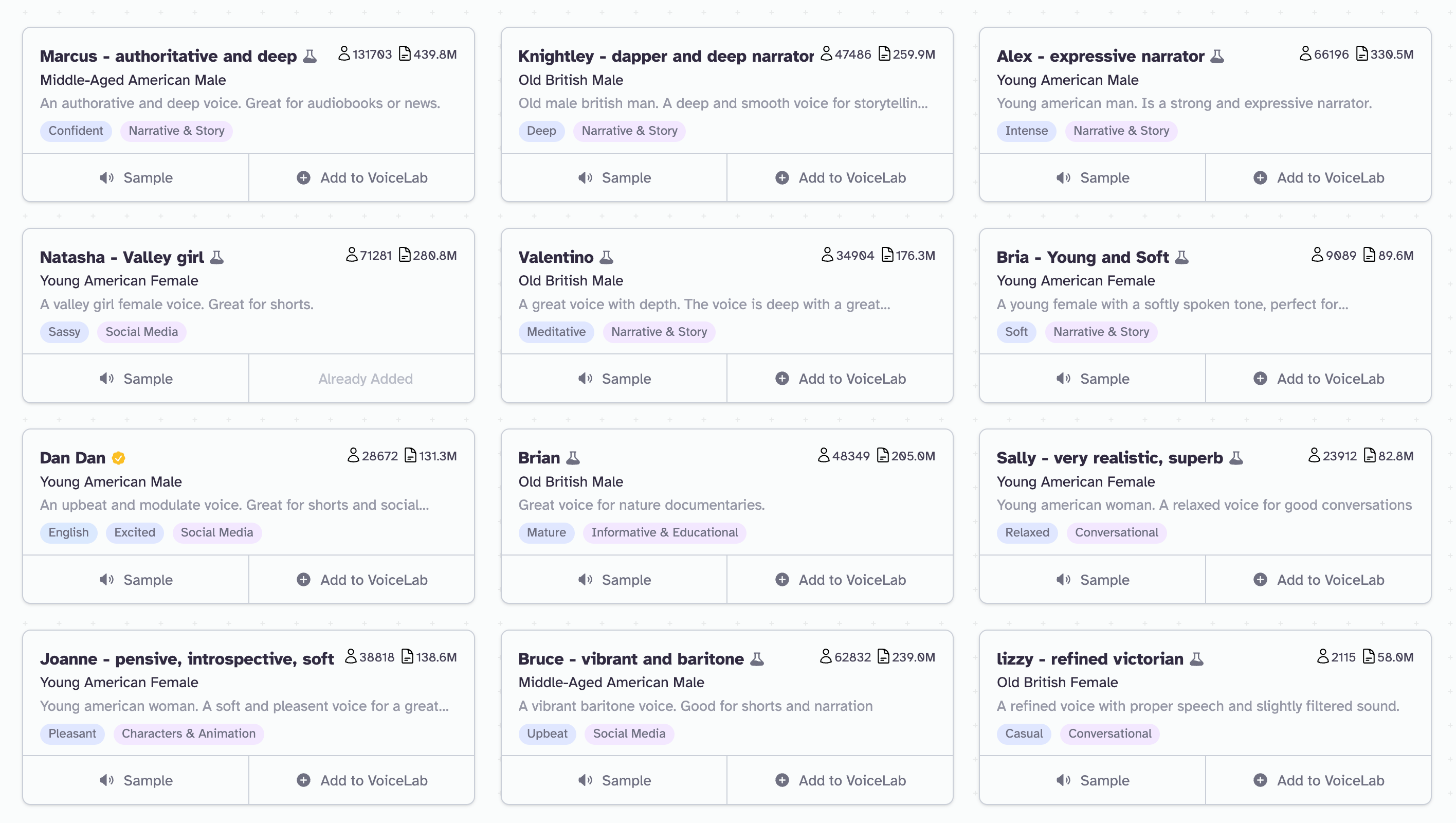
ElevenLabs offers a range of different voices, some synthesized and some cloned from voice actors.

ElevenLabs has also faced criticism from voice actors who claim the company has used samples of their voices without their consent, which could be used to promote content they don’t endorse or spread misinformation and disinformation. In a recent Vice article, victims described how ElevenLabs was used in harassment campaigns against them, one example being the use of cloned voices to share actors’ private information (their home addresses).

And then there’s the elephant in the room: platforms like ElevenLabs pose an existential threat to the voice-over community.

Motherboard writes that voice actors are increasingly being asked to give up the rights to their voices so that clients can use artificial intelligence to generate synthesized versions that can eventually replace them—sometimes without corresponding compensation. The fear is that voice-over jobs – especially cheap, entry-level jobs – will eventually be replaced by AI-generated voices, and actors will have no recourse.

Some platforms are trying to strike a balance. Earlier this month, ElevenLabs competitor Replica Studios signed a deal with SAG-AFTRA to create and license digital reproductions of the voices of Media Artists Alliance members. The arrangements set out “fair” and “ethical” terms and conditions to ensure performers’ consent and negotiated terms for the use of digital voice avatars in new productions, the organizations said in a release.

However, even that dissatisfied some voice actors – including members of SAG-AFTRA themselves.

ElevenLabs’ solution is a voice marketplace. The marketplace is currently in alpha stage and will become more widespread in the coming weeks, allowing users to create sounds, verify and share it. Staniszewski said the original creator is compensated when others use the sound.

“Users always retain control over their voice availability and compensation terms,” ​​he added. “The marketplace is designed to align AI advancements with established industry practices while also bringing diverse voices to ElevenLabs’ platform.”

However, voice actors may take issue with the fact that ElevenLabs doesn’t pay cash – at least not yet. The current setup gives creators credit for ElevenLabs’ premium service (which I bet some people find ironic).

Perhaps this will change in the future, as ElevenLabs (currently one of the best-funded synthetic speech startups) attempts to defeat upstart competitors such as Papercup, Deepdub, ElevenLabs, Acapela, Respeecher, and Voice.ai, as well as large tech companies , such as Amazon, Microsoft and Google. Regardless, ElevenLabs plans to increase its headcount from 40 to 100 employees by the end of this year, and intends to stay and make waves in the fast-growing synthetic speech market.

Source link


from Tech Empire Solutions https://techempiresolutions.com/voice-cloning-startup-elevenlabs-raises-80-million-achieves-unicorn-status/
via https://techempiresolutions.com/

Back to topic #2: Combating B2B COVID-19 Scams Office Doors

This is what you have to say about scammers: they follow current events. As early as February 2020, scammers were already using the coronavirus as a scam, and the Federal Trade Commission (FTC) issued an alert to consumers. Soon after, scammers were targeting businesses as well. Now that many companies are returning to in-person workplaces, some fraudsters will try to take advantage of this shift. As you return to business as usual, be wary of these forms of B2B deception.

Avoid COVID-19 Vaccine Certificate FraudSpot the signs of an imposter scam. Since the outbreak began, the FTC has received reports of scammers using telemarketing calls, emails and even fake apps to impersonate government employees or public health officials. Now we’re hearing about the “vaccine certificate” scam.what is operating mode? They are suddenly offering businesses and consumers official-sounding but false information, so-called national vaccine certificates, “passports” or “verification apps.” Their real purpose is to steal money or personal information. The FTC provides tips for spotting this form of fraud as well as recommendations for increasing protection against imposter scams.

Stick with suppliers you know or who are recommended by people you trust. This time last year, companies were scrambling to source masks, disinfectants and other essentials. When businesses order from unfamiliar websites that promise fast shipping of scarce products, they often find themselves empty-handed. As manufacturers prepare and offices reopen, some industries are reporting shortages of raw materials — conducive to supply chain scams. It’s wiser to stick with suppliers who have proven reliable in the past or who are recommended by trustworthy colleagues.

Alert your employees about unemployment benefits fraud. Throughout the pandemic, the FTC has asked public-spirited businesses and consumers to contact us at ReportFraud.ftc.gov about suspicious behavior you observe. The reports highlight fake unemployment claims filed by scammers using the names, dates of birth and Social Security numbers of people who are not unemployed. It affects tens of thousands of people and costs states hundreds of millions of dollars. what can you do? Employees who suspect their personal information has been compromised in this manner are asked to report it online to the appropriate state unemployment insurance office and are advised to visit Identitytheft.gov for step-by-step guidance.

Next in the Back to Business series: Looking for small business financing?

Source link


from Tech Empire Solutions https://techempiresolutions.com/back-to-topic-2-combating-b2b-covid-19-scams-office-doors/
via https://techempiresolutions.com/

Best PDF Editor: Document 365 Lite 73% off

Long story short: A lifetime subscription to the Document 365 Lite Personal plan is priced at £63.06, a saving of 73% on the list price.


Those who work in the professional business world—from full-time office workers to part-time couch potatoes—know the frustrations that come with plans that limit productivity. Unless you have an Adobe subscription, you may have issues viewing and editing PDFs, but we may have a solution.

Document 365 is an application designed for the increasingly mobile workplace to view, edit and sign PDFs across devices. Find the lowest price online for a limited time: £63.06 for a lifetime subscription.

With Document 365, you can say goodbye to PDF headaches or expensive subscriptions. The next time you receive a PDF (whether you’re at the office on your desktop, at the coffee shop on your laptop, or on your phone while commuting), you can view, edit, markup, sign, convert, and more with File 365.

Let’s take a look at the most notable features of Document 365:

Mix and match offer

  • Edit: Added text boxes, highlights, annotations, etc.

  • Manage: Sign, fill out forms, organize pages, split or merge PDF files, and attach voice memos.

  • Scan: Convert paper documents into searchable PDF or editable text files using optical character recognition (OCR).

  • Convert: Change files to or from PDF format.

  • Security: Protect your apps, scans, and PDFs with password protection and watermarks.

A lifetime subscription to Document 365 means you can use the program on up to five devices (including iOS, Android, Mac and Windows) for life after a one-time payment. Say goodbye to the traditional barriers of PDF and Adobe subscription fees with this cross-device file solution.

Get Document 365 at the lowest price on the internet for a lifetime subscription, priced at £63.06.


Source link


from Tech Empire Solutions https://techempiresolutions.com/best-pdf-editor-document-365-lite-73-off/
via https://techempiresolutions.com/

Sunday, January 21, 2024

TikTok usage is starting to slow down – is TikTok Shop to blame?

TikTok may be the world’s No. 1 app in 2023 by downloads and consumer spending, but it’s not at the top of the list by actual usage. Last year, Facebook once again retained its No. 1 spot for monthly active users, followed by Meta’s other apps WhatsApp, Instagram and Messenger, all of which were ahead of fifth-ranked TikTok. Now new data suggests TikTok has outgrown TikTok. The slowdown has begun, raising the question of whether the app’s foray into e-commerce via TikTok Shop is to blame.

The latest data from market intelligence company Sensor Tower shows that although TikTok’s growth is still positive, it is slowing down. In 2022, TikTok’s monthly active users will increase by an average of 12% per quarter, but this number will decrease to 3% per quarter in 2023.

The change comes after TikTok launched TikTok Shop in the U.S.

The video app began testing Shop in the United States in November 2022, and the scope of the test was expanded early last year as more and more brands joined, including PacSun, Revolve, Willow Boutique, and beauty brand KimChi Chic. While the store won’t “officially” launch in the U.S. until September 2023, it’s just one of several efforts to translate the power of TikTok videos (essentially the whole “TikTok made me buy it” meme) into real-world sales one.

Last summer, for example, TikTok experimented with an in-app shopping section in the UK called “Trendy Beat,” which offered products sold by TikTok parent company ByteDance. TikTok also offers an affiliate program that allows creators to earn commissions from products, according to The Associated Press and other media reports.

But as Business Insider noted in November, sellers’ embrace of the shopping platform has begun to spark complaints, with some lamenting that TikTok Shop is turning the app into an “ad-filled wasteland” and a “dystopia.” space. Elsewhere around the web, Reddit users have been debating whether TikTok Shop has “ruined” the app, which is now filled with “people dropshipping/selling cheap products,” as one Reddit user put it.

“Personally, I started getting really annoyed with almost all my other videos. [For You Page] Someone is exaggerating a product in the store feature in an attempt to make it go viral and make a huge commission,” Reddit user u/megg-salad-sammich wrote in September. “This is a new way for creators to make money, which is great, but I find myself scrolling less and less because I know almost every video is just trying to get me to buy something random,” they said.

A search on Reddit revealed more posts throughout the last year complaining about the same thing—that TikTok was now “annoying” because of TikTok Shop, and that seeing ads every few videos was a frustrating experience.

While TikTok users are adapting to their favorite social network becoming an online mall, TikTok’s Shop Seller app, which powers its e-commerce initiatives, has grown.

Sensor Tower data shows that Shop Seller’s growth has been “robust” since the fourth quarter of 2022, with year-on-year growth of 230% as of the fourth quarter of 2023. However, the app accounts for only a small portion of TikTok’s active user base—currently 1.4 billion as of the first quarter of this year. Meanwhile, Shop Seller has only about 6 million monthly active users, the company reported.

Instagram may end up benefiting from user dissatisfaction with TikTok Shop, as the Meta-owned app removed its own store tab last January and canceled on-site shopping in March. This may make it more palatable to those who want to avoid a more direct call to people to shop within the app.

Meta’s move was triggered by broader industry trends, which doesn’t seem to bode well for the future of TikTok Shop. Live streaming shopping has boomed during the epidemic, and e-commerce sales have surged. But when things return to normal, social commerce (including live shopping) will only account for about 5% of total U.S. e-commerce sales as of 2022. This seems to indicate that U.S. consumers may not be ready to shop directly from movies, although they are clearly still influenced by online trends.

However, users are yet to become dissatisfied with TikTok Shop and abandon the app in favor of Instagram Reels.

Sensor Tower found that Instagram’s monthly active user growth has been relatively stable in the “mid-single digits” and has not been significantly negatively or positively impacted since the launch of the TikTok Shop Seller app.

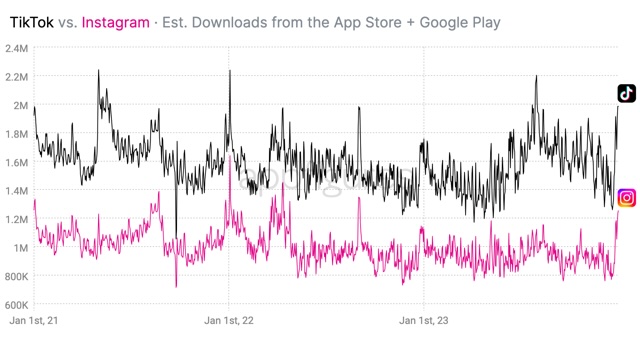
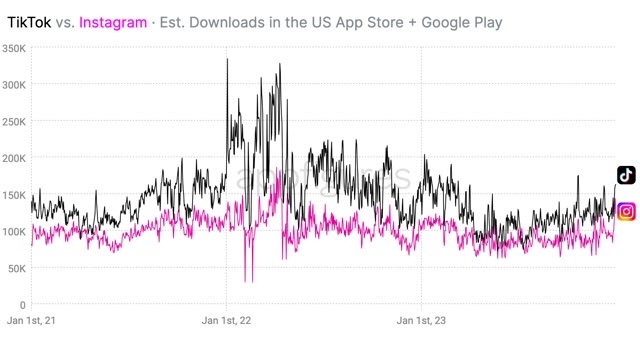
Data from another company, Appfigures, also supports this conclusion, but adds that while TikTok’s revenue has been growing, its downloads have stagnated or declined more than they have grown — a trend that has continued for more than a year. Includes global and other regions.USA

Image Source: Application characters

Image Source: Application characters


Source link


from Tech Empire Solutions https://techempiresolutions.com/tiktok-usage-is-starting-to-slow-down-is-tiktok-shop-to-blame/
via https://techempiresolutions.com/

Why Supreme Court ruling on fishing boats could change everything

The Supreme Court heard oral arguments this week in several cases that could completely upend the way federal agencies regulate anything in the United States. At issue is a legal doctrine called “Chevron Deference,” which allows federal agencies to interpret laws designed to protect consumers, public health and the environment. Now, the Supreme Court’s conservative supermajority appears to be on the verge of overturning or limiting the scope of Chevron’s deference.

edge spoke with legal experts about what’s happening and what the Supreme Court’s Chevron deference ruling ultimately means for Americans. “The real question is how far can they go?” said Jody Freeman, director of the Environmental and Energy Law Program at Harvard University. “In fact, they could overturn this precedent. That could lead to considerable uncertainty and confusion.”

“In fact, they could overturn this precedent. That could lead to considerable uncertainty and confusion.”

What is the Chevron Doctrine?

Essentially, if there is a dispute over how to interpret language passed by Congress, it allows judges to defer to federal agencies when determining how to implement the law. Assume that the agency has more expertise on the matter than the federal judge assigned to the case.

Ian Fein, senior adviser to the nonprofit Natural Resources Defense Council, said the practice has been around since before the naming. After a 1984 case, it became known as the Chevron Doctrine, Chevron USA, Inc. v. Natural Resources Defense Council (NRDC). Interestingly, NRDC, an environmental organization, actually lost the case, and the Supreme Court upheld the ruling in favor of Chevron. It allowed the industry-friendly EPA of the Ronald Reagan era to insist on its own loose interpretation of the Clean Air Act.

But since then, Chevron’s deference has allowed agencies to take initiatives on issues that may not have been addressed by legislation, such as climate change and broadband access. This has sparked debates, for example, about how far the EPA can regulate greenhouse gas emissions under the Clean Air Act and how far the FCC can go in enforcing net neutrality.

Why is the Supreme Court getting involved now?

Fein said that despite initial support from conservative groups, compliance with Chevron has recently become a target for industries pushing a deregulatory agenda. “Over the last decade or so, there’s been an effort to question that doctrine and overturn it,” Fein said. edge. During the Obama administration’s second term, Fein said, “we began to view overturning Chevron’s deference as a way to undermine the ability of federal agencies to enforce federal laws.”

Two cases have reached the Supreme Court that jeopardize long-standing Chevron principles: Loper Bright Enterprises v. Raimondo and Relentless, Inc. v. Department of Commerce. Plaintiffs in both cases challenged a rule that requires fishing companies to pay for observers they are legally required to have on board ships to monitor their operations. They asked a judge to overturn Chevron’s ruling and were supported by other industry groups including Gun Owners of America and e-cigarette manufacturers.

“It cannot be overstated how broad and fundamental this principle is to the operation of our federal government.”

Erich Platt, senior vice president of Gun Owners of America, said in a statement last year: “Joe Biden and his predecessors used the broad powers given to them by Chevron to go after law-abiding people on multiple separate occasions. Gun owners.” “Americans have had enough of one man pursuing the rights guaranteed by our Constitution with a pen, and we urge the court to overturn Chevron’s decision.”

If they succeed, they could force an overhaul of the way the U.S. regulates industry — stripping power from federal agencies and placing more responsibility in the hands of federal courts.

“It cannot be overstated how broad and fundamental this principle is to the operation of our federal government,” Fein said. “It describes the basic rules or foundation of the system we have [operates] — Federal agencies and courts that enforce regulations and serve as backstops. “

What would happen if the Supreme Court decided to overturn Chevron?

“This is really going to create a period of confusion as federal courts are deciding what they think all these laws mean,” Freeman said. edge. “This could create a lot of inconsistency and confusion across agencies and regulated parties.”

Freeman was interviewed in full this Harvard Gazette This details how much confusion such a decision would cause for the courts:

Chevron didn’t matter to the Supreme Court, which largely ignored it. But it does matter to lower courts, which continue to use the two-step test to manage a flood of lawsuits challenging agency interpretations ranging from the most general to the most complex. When a statute is unclear, courts will consider whether an agency’s interpretation is sensible, reasonable, and consistent with the design of the statute. If so, the agency wins. Without Chevron, federal judges could be mired in complex legal interpretation issues that require scientific, economic or technical expertise. Policy choices that are more appropriate for agencies with research and information-gathering capabilities and a duty to consult with stakeholders will increasingly be made by federal judges, who have no expertise and do not know how to do these things.

Even Trump-appointed Justice Brett Kavanaugh acknowledged during oral arguments Wednesday that denying Chevron deference could be a “shock” to the legal system, though he downplayed the long-term impact of such a shock . He dismissed this, saying, “Every four or eight years when a new government takes office, whether it is communications law, securities law, competition law or environmental law, there will be an impact on the system.” New York Times Report.

While Chevron deference as we know it may not survive the Supreme Court’s 6-3 conservative supermajority, the justices could choose to set limits on when deference can be granted rather than jettison the principle entirely. “Regardless, I think in this moment it’s going to be harder for federal agencies to do the jobs they have to do,” Freeman said. When congressional gridlock becomes a major obstacle to passing legislation, the responsibility for taking action often falls on federal agencies.

So this is a big deal, right?

Yes. There is more to consider than fishing.

“This is going to be a very important decision for the balance of power between Congress, the president and the courts. That’s why the stakes are so high,” Freeman said. “It looks like the Supreme Court is gaining more and more power relative to the other two branches. We should be worried about that.”

The Supreme Court has made a series of recent decisions that have curtailed the power of federal agencies, in particular one decision that reinforced the “significant question” doctrine State of West Virginia v. Environmental Protection Agency. Under this doctrine, courts are not required to defer to federal agencies on matters of national significance that Congress has not expressly enshrined in legislation.

The Supreme Court is expected to issue a ruling on Chevron’s compliance in late June.

Source link


from Tech Empire Solutions https://techempiresolutions.com/why-supreme-court-ruling-on-fishing-boats-could-change-everything/
via https://techempiresolutions.com/

Chuzo Login

How to Login to Chuzo Are you having trouble logging into Chuzo? Let’s explore this guide to trouble shoot your problems. Make Sure...